How to Trade Binary Options with the Vortex Indicator and a Moving Average
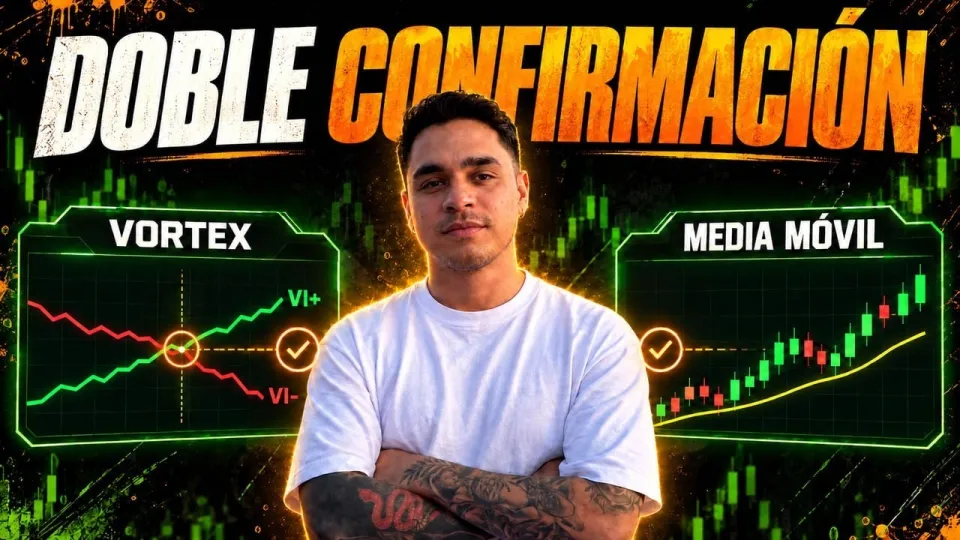
Video: Opciones Binarias! Vortex y media móvil — cuándo entrar y cuándo!
· based on the channel Trader Loco 📈
Key takeaways
- The Vortex indicator gives the entry signal, the moving average acts as a filter that confirms direction.
- A trade is valid only when the Vortex crossover and the price position relative to the moving average agree.
- In a flat or sideways market both signals contradict each other, so the setup is skipped.
- Signals that appear before the moving average confirms direction are discarded, not traded.
- Waiting for both conditions costs trades but removes the worst entries.
Binary options with the Vortex indicator and a moving average are traded on one simple rule: the Vortex crossover shows momentum shifting, and the moving average confirms that the shift goes with the trend, so a position is opened only when both agree. If the two indicators disagree or price is stuck in a range, the correct action is to skip the signal and wait. This is the framework the Trader Loco 📈 channel breaks down in its review of the Vortex plus moving average setup, and you can test the approach with the free trading bot available at the Trader Loco bot.
What the Vortex indicator actually measures
The Vortex indicator is a two-line momentum tool built from directional movement: one line tracks upward pressure, the other tracks downward pressure, and their crossing marks a shift in who controls the price. It was designed to catch the start of a trend rather than its middle, which is why it produces frequent crossovers — and why so many of them are noise.
Two details matter for binary options specifically:
- The cross itself is not a signal; it is only a candidate. On its own it fires in ranges, during news spikes and at the end of exhausted moves.
- Because binary options pay a fixed amount and expire at a fixed time, a false crossover is not a small loss — it is a full loss of the stake. Precision matters more than frequency.
The practical consequence is that Vortex should never be traded alone. It needs a second, slower opinion about direction, and that is exactly the role the moving average plays in this setup.
How the moving average confirms a Vortex crossover
The moving average is the filter: it defines the prevailing direction, and the Vortex crossover is only accepted when it points the same way. A simple way to express this in rules:
- Define the trend with the moving average — price above the MA means an upward bias, price below it means a downward bias.
- Wait for the Vortex lines to cross in the direction of that bias: an upward cross while price holds above the MA, a downward cross while price holds below it.
- Ignore any crossover that happens against the moving average, even if it looks sharp.
- Enter only after the crossover candle closes, never in the middle of it, so the signal is confirmed rather than anticipated.
The moving average period should be slow enough to represent the trend of the timeframe you trade and fast enough to react before the move is over. On short expiries a shorter MA is used, but the logic does not change: the MA says which side you are allowed to trade, and Vortex says when.
When to stay out of the market
The most valuable part of this strategy is the list of conditions under which no trade is taken. A sideways market is the single biggest killer of Vortex-based binary options trading, because in a range the indicator crosses repeatedly in both directions while the moving average stays flat and price chops around it.
Skip the setup when:
- the moving average is flat and price keeps crossing it back and forth;
- the Vortex lines cross but price sits on the wrong side of the MA;
- the crossover happens right at the MA, where there is no confirmed direction yet;
- the candles are small and overlapping, with no clear impulse behind the cross.
A flat market is not a signal to trade smaller — it is a signal to close the terminal and wait for a trend to appear. Traders who take every crossover in a range usually give back everything they earned during the trending session.
Reading the first signals and discarding the weak ones
At the open of a session the Vortex lines often cross before the moving average has decided on a direction, and those first crossovers are the ones most often thrown away. The disciplined approach is to treat them as information, not as entries:
- Mark the first crossover and check where price stands relative to the MA. If the MA is still flat or price is pinned to it, the signal is discarded.
- Wait for the MA to take a clear slope and for price to hold on one side of it.
- Only then accept the next Vortex crossover that agrees with the MA direction.
This is why two traders watching the same chart can take different trades: one enters on the raw crossover, the other waits for the second condition. The second trader takes fewer positions but avoids the entries that were never confirmed.
A checklist for entering only when both indicators agree
Both indicators agreeing is a binary condition — either the Vortex crossover and the MA direction match, or the trade does not exist. Before clicking, run through the same short checklist every time:
- Is the moving average sloped, not flat?
- Is price clearly above or below the MA, not sitting on it?
- Has the Vortex crossover completed on a closed candle?
- Does the crossover direction match the MA bias?
- Is there a visible impulse behind the move rather than a drift?
If any answer is no, the position is not taken. If all five are yes, the entry is made with the expiry that matches the timeframe of the signal, and the stake follows the risk limit set for the session rather than the confidence felt about the particular trade.
Common questions from traders using this setup
Most doubts around the Vortex and moving average combination come down to patience and to the tools used alongside it. Beginners often ask how many signals per session they should expect — in a trending market, very few, and in a range, none worth taking. Others ask whether a bot can replace the judgment: a bot can execute the rules faster and without hesitation, but the rules themselves still have to be defined, and the free Trader Loco bot is a way to test them on a demo-style flow before risking real money.
Another recurring concern is the expiry. A crossover on a short timeframe does not justify a long expiry, because the momentum it measures fades quickly; matching expiry to timeframe keeps the trade consistent with the signal. Finally, traders ask whether a losing streak means the strategy is broken. Usually it means the market turned flat and the filter was ignored — the fix is to reapply the no-trade conditions, not to add indicators.
Useful links
- Free trading bot: https://t.me/loco_trader_bot?start=yt_26_1710
- Live strategies and signals: https://t.me/+vag-Dm5afvRiNGNi
- Registration with the promo code «LOCO» and a +60% bonus: https://trader-loco.pro/register
Final thoughts on patience over signal count
The Vortex and moving average combination is not a high-frequency system; it is a filter that removes most of the trades a raw crossover would generate. Its edge comes from refusing to trade when the two indicators disagree, which in practice means sitting out flat markets and unconfirmed crossovers. Traders who count signals will find it frustrating, while traders who count avoided mistakes will find it useful. The breakdown of this approach comes from the Trader Loco 📈 channel, and the free bot at the Trader Loco bot is the quickest way to see how the rules behave on live charts before committing capital.
Questions & answers
Do I need both the Vortex indicator and the moving average to trade this setup?
Yes. The Vortex crossover alone fires too often in ranges and at exhausted moves, so the moving average is used as a direction filter. A trade is only valid when the crossover direction matches the side of the moving average price is trading on.
How many signals should I expect per session?
Fewer than most beginners expect. In a clear trend you may see only a handful of confirmed crossovers, and in a sideways market none of them qualify. If you are getting many signals, the filter is probably being ignored.
Can a trading bot run this strategy for me?
A bot can execute defined rules faster and without hesitation, but it cannot invent the rules. You still need to specify the crossover, the moving average period and the no-trade conditions, then test the setup before risking real money.
What expiry should I use after a confirmed crossover?
Match the expiry to the timeframe that produced the signal. A crossover on a short timeframe reflects short-lived momentum, so a long expiry takes the trade away from the condition that justified it.
Source: Opciones Binarias! Vortex y media móvil — cuándo entrar y cuándo! · Markdown version